
News & Events
How to Pay for Esthetician School: A Complete 2026 Funding Guide

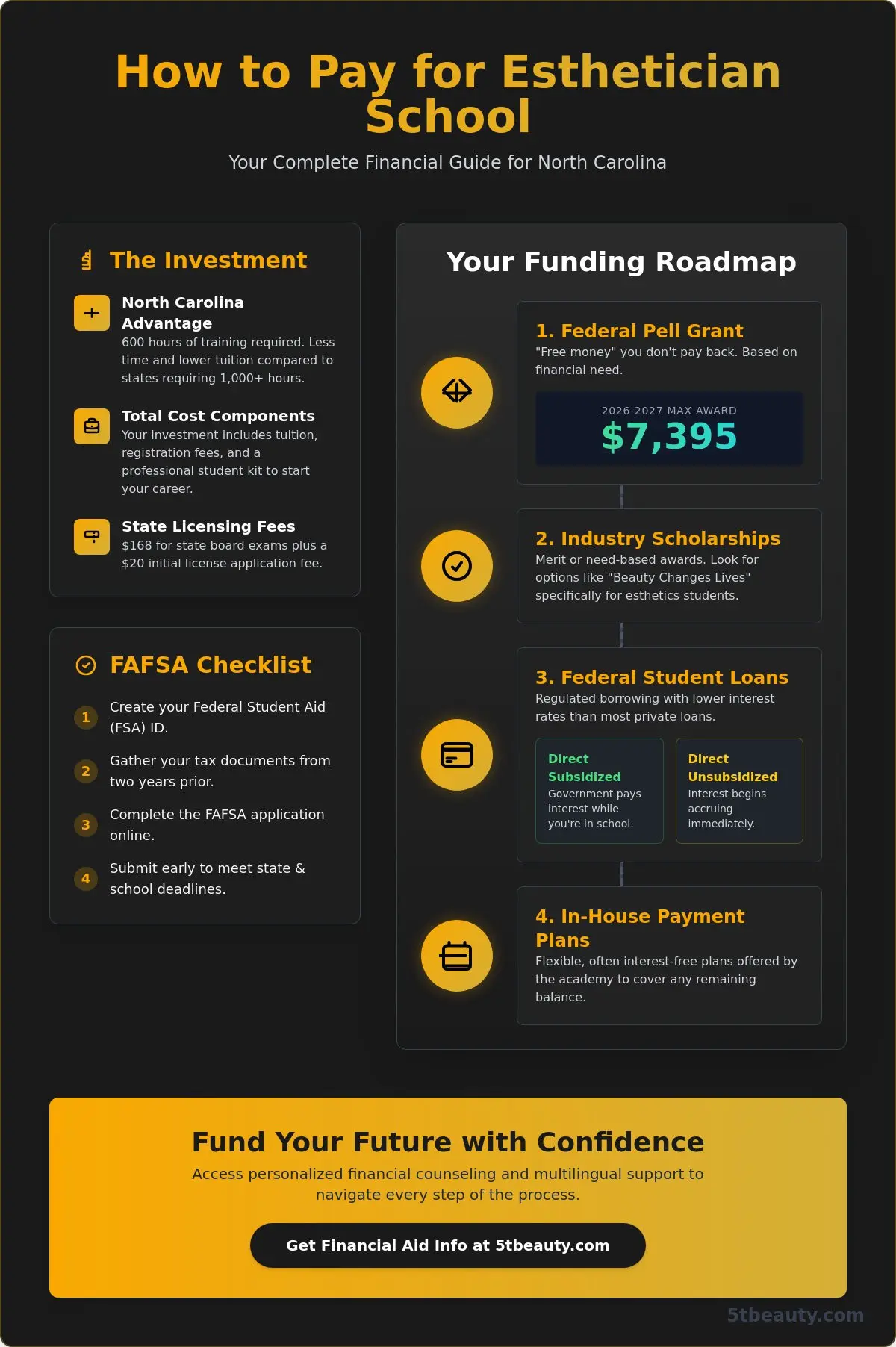
Did you know that the maximum Federal Pell Grant for the 2026-2027 award year is $7,395, which could cover nearly the entire cost of some North Carolina programs? It’s natural to feel a bit of anxiety when looking at tuition numbers or trying to decode FAFSA eligibility requirements. You want to start your career as a skin care specialist, but the fear of high-interest debt can make the finish line feel out of reach. We believe that financial barriers shouldn’t stop you from pursuing your passion. Understanding how to pay for esthetician school is the first step toward your professional transformation.
This guide provides a clear roadmap of your funding options, from federal grants to the flexible payment plans offered by many private academies. You’ll learn how to layer different types of aid to minimize out-of-pocket costs while completing your 600 hours of required training. We’ll help you understand the long-term value of your education so you can focus on mastering services like acne treatment facials and eyelash extensions. Let’s explore how you can fund your future with confidence and clarity.
Key Takeaways
- Learn how North Carolina’s 600-hour training requirement shapes your total investment in tuition and professional kits.
- Discover how to secure federal Pell Grants of up to $7,395 to fund your journey toward becoming a skin care professional.
- Identify high-value industry scholarships like Beauty Changes Lives that are specifically designed for aspiring esthetics students.
- Master how to pay for esthetician school by combining federal aid with flexible, interest-free in-house payment plans.
- Access personalized financial counseling and multilingual support to help you navigate every step of the FAFSA application process.
Understanding the Cost of Esthetician School in North Carolina
North Carolina mandates exactly 600 hours of supervised training at a Board-approved school to qualify for your license. This requirement is a major advantage for local students. While some states demand 1,000 hours or more, the NC standard keeps your total tuition investment lower and gets you into the workforce faster. When you’re researching how to pay for esthetician school, you must look beyond just the sticker price. A complete budget includes tuition, registration fees, and your professional student kit.
Beyond the classroom, you need to account for mandatory state expenses. The North Carolina Board of Cosmetic Art Examiners charges $168 for the theory and practical exams combined. There is also a $20 initial license application fee. As you explore Cosmetology and esthetician careers, you’ll find that specialized training is the foundation of long-term success. Choosing the cheapest program might seem tempting, but it often leads to higher costs later. Low-cost schools may have high student-to-teacher ratios or provide low-quality kits that you’ll have to replace before you even graduate. Quality instruction ensures you master safety protocols and advanced techniques, which are essential for passing your exams on the first try.
Raleigh vs. National Tuition Averages
Raleigh is a competitive hub for beauty education, which often keeps local tuition more predictable than in major metros like New York or Los Angeles. Attending an esthetician school raleigh nc allows you to build a local professional network while you study. You should also factor in your daily cost of living. Since the program requires 600 hours, many students choose full-time schedules to finish in about four to five months. This fast pace requires careful planning for your rent and transportation during those months of intensive study.
What is Included in Your Tuition?
Most reputable programs bundle several essential items into your total cost. Your professional skincare kit is a significant part of this value. These kits often include the tools you’ll use for acne treatment facials and chemical peels during your student clinic hours. You don’t just use these tools; you keep them to start your career. Your tuition also covers your classroom hours and the hands-on practice required by the state. Look for programs that include comprehensive state board preparation and mock exams. These resources are vital for building the confidence you need to earn your license. Understanding these components helps you see how to pay for esthetician school as a strategic investment in a high-growth career.
Maximizing Federal Financial Aid and Grants
Securing federal funding is often the most effective strategy for students determining how to pay for esthetician school. The Federal Pell Grant is the centerpiece of this effort because it provides “free money” that you don’t have to pay back. For the 2026-2027 award year, the maximum Pell Grant is $7,395. This amount can cover a significant portion of your tuition at an accredited institution. Eligibility depends on your financial need, which is determined after you submit your application. To understand your specific award, it helps to learn how federal financial aid is calculated based on your Student Aid Index and the cost of attendance.
If grants don’t cover your entire balance, federal student loans offer a regulated fallback. Direct Subsidized Loans are ideal because the government pays the interest while you’re in school. In contrast, Direct Unsubsidized Loans begin accruing interest immediately. Both options generally offer lower interest rates than private loans. When you receive your financial aid award letter, look closely at the “Net Price” after all grants are applied. This clear breakdown helps you see exactly what remains. Our team at 5T Beauty Academy can help you review these documents to ensure you’re maximizing every available dollar.
The FAFSA Process for Beauty Students
Your journey begins with the Free Application for Federal Student Aid (FAFSA). Start by creating your FSA ID and gathering your tax documents from two years prior. Speed is essential for North Carolina students. While the final federal deadline for the 2026-2027 cycle is June 30, 2027, state priority deadlines are much earlier. For community colleges, the deadline is August 15, 2026. Private institutions often award funds on a first-come, first-served basis starting as early as October 1, 2025. Avoid common mistakes like using the wrong school code or failing to sign the form electronically. These errors can delay your funding for weeks and might cause you to miss a specific enrollment window.
Federal Work-Study and Vocational Rehabilitation
Beyond traditional grants, look into federal work-study programs. These allow you to earn money through part-time employment, often on campus, to offset the cost of books and supplies. North Carolina also offers robust vocational rehabilitation programs. These are specifically designed for individuals who may need additional support or training to re-enter the workforce. If you’re an adult learner returning to school, you might qualify for niche grants that support career transitions. Using these resources in combination with your Pell Grant is the smartest way to figure out how to pay for esthetician school without relying solely on high-interest debt.
Beauty Industry Scholarships and Local NC Grants
While federal aid provides a strong foundation, scholarships are the extra mile that can eliminate your need for student loans entirely. Many students overlook these opportunities because they assume the competition is too high. In reality, hundreds of beauty industry awards go unclaimed every year because of a lack of applicants. When you’re figuring out how to pay for esthetician school, private scholarships should be your next stop after the FAFSA. These funds are gifts that you never have to repay, making them the most student-friendly way to cover your costs.
The Beauty Changes Lives foundation is perhaps the most well-known, offering multiple cycles of funding throughout the year for aspiring skin care specialists. Another excellent resource is the Joe Francis Haircare Scholarship Foundation, which supports students in various cosmetic arts. You can find a comprehensive list of these and other Professional Beauty Association scholarships on their official website. Winning these awards often requires a short video or a personal essay. Focus your writing on your specific career goals, like opening a boutique spa in Raleigh or specializing in acne treatment facials. Your passion is what will set your application apart from the rest.
Where to Find Esthetics Scholarships
Look beyond the national names. Professional organizations like Associated Skin Care Professionals (ASCP) offer exclusive grants to their student members. You should also research the specific skincare brands used in your school’s curriculum. Many high-end lines offer grants to students who show exceptional skill in their proprietary methodologies. Locally, Raleigh-based business associations and the North Carolina Community Foundation provide vocational scholarships specifically for Triangle residents. These local awards often have fewer applicants than national ones. This gives you a much higher chance of success when you apply.
Bilingual and Community-Focused Funding
The Triangle area is home to a diverse community of aspiring professionals. If you speak more than one language, you have access to niche funding designed to support inclusivity in the personal care industry. Resources for Spanish and Vietnamese speaking students are becoming more common as the demand for multilingual services grows. Choosing a bilingual beauty school nc can connect you with these specific community-based workforce development funds. These organizations value your ability to serve a wider range of clients.
Many of these programs are managed by local non-profits that want to see residents succeed in high-demand trades. They may provide assistance not just for tuition, but for the $168 state exam fee or your initial $20 licensing fee. Combining these community grants with industry scholarships creates a robust plan for how to pay for esthetician school without the stress of high-interest debt. Start your applications as soon as you choose your program to give yourself the best possible advantage.
Flexible Payment Plans and Private Financing
Grants and scholarships are fantastic resources, but they don’t always cover the full balance of a professional program. If you’re still looking for ways how to pay for esthetician school, institutional financing and private options provide the flexibility you need. Many students prefer to avoid traditional bank loans because of high interest rates and rigid credit requirements. Instead, they look for schools that offer in-house solutions designed for the working professional. These plans allow you to invest in your future without the immediate burden of a massive upfront payment.
If you choose to explore private student loans, it’s vital to shop around for the best terms. As of May 2026, fixed interest rates for private student loans typically range from 2.69% to 17.99%. While these can bridge the gap, they should be used strategically. You might also consider using a 529 savings plan. While often associated with four-year universities, these tax-advantaged accounts can frequently be used for tuition and fees at accredited vocational schools. Some employers in the Raleigh wellness industry even offer tuition reimbursement for staff members who are pursuing their license while working in support roles. We invite you to explore our program options to see how we can help you build a personalized financial path.
In-House Financing vs. Bank Loans
School-specific payment plans often provide a much friendlier alternative to bank loans. These plans are usually interest-free and don’t require the same intensive credit checks as a financial institution. Typically, you’ll provide a down payment at the start of your 600-hour journey and then make manageable weekly or bi-weekly installments. This structure helps you maintain a realistic monthly budget that covers both your tuition and your daily living expenses. It’s a transparent way to manage costs while you focus on mastering advanced skincare techniques.
Working While in School: The Raleigh Strategy
Balancing a job with a full-time esthetics schedule requires a smart approach to your time. Raleigh offers a thriving wellness market where you can find flexible part-time roles that complement your studies. Many students find work as spa coordinators or beauty retail specialists to stay immersed in the industry. This “pay-as-you-go” model reduces your reliance on debt and builds your professional network simultaneously. You’ll gain even more confidence by participating in student clinic services raleigh, where you apply your skills to real clients under expert supervision. This hands-on experience is invaluable. It ensures that when you graduate, you aren’t just licensed; you’re ready to excel in a high-end spa environment immediately.
Why 5T Beauty Academy is an Accessible Career Investment
Choosing the right institution is just as vital as figuring out how to pay for esthetician school. At 5T Beauty Academy, we view your financial stability as a foundation for your professional success. Our admissions team provides personalized financial counseling to help you navigate FAFSA applications and federal grants. We know that the process can feel overwhelming. That is why we provide a nurturing environment where your questions are welcomed and answered with professional authority. We want you to feel confident in your investment from day one.
Our commitment to inclusivity sets us apart. We offer dedicated bilingual support in English, Vietnamese, and Spanish for all financial paperwork and enrollment documents. This ensures that every student, regardless of their primary language, has equal access to funding opportunities. We also provide flexible full-time and part-time schedules. These options allow you to balance your 600 hours of training with your current job or family life. By reducing the stress of scheduling, we help you focus on mastering advanced treatments like acne treatment facials and chemical peels.
The 5T Beauty Difference in Financial Support
Our admissions team does more than just hand you a brochure. We actively assist with bilingual grant applications to remove language barriers that often hinder access to federal aid. We believe in transparent pricing. You will never encounter “surprise” fees mid-semester for registration or administrative costs. This clarity allows you to plan your budget with precision. We respect your time and your resources, providing a structured path that values your personal progress as much as your technical skill.
Investing in Your Future Career
It is wise to compare different vocational paths before committing. You might explore the costs and benefits of our nail technician school raleigh program versus our esthetics curriculum. Both fields offer excellent ROI in the North Carolina market. Being a bilingual licensed professional gives you a significant competitive edge. You’ll be prepared to serve a diverse range of clients in the Triangle area immediately after graduation. Our program is specifically designed to help you pass the NIC Esthetician Written and Practical exams with a score of 75% or higher on your first try. This focus on first-time success saves you from the extra $168 in re-testing fees and gets you into the workforce faster. Book a tour today to receive a custom quote and discover how to pay for esthetician school through our supportive enrollment process.
Take the First Step Toward Your Esthetics Career
Your path to becoming a licensed skin care professional in North Carolina is closer than it feels. By layering federal Pell Grants with industry scholarships and flexible in-house financing, you can manage your 600-hour training without the burden of high-interest debt. Remember that the right school does more than teach technical skills; it acts as your partner in navigating the financial landscape. Understanding how to pay for esthetician school is simply the first practical hurdle on your journey to professional success.
At 5T Beauty Academy, we’re proud to be licensed by the NC Board of Cosmetic Art Examiners and dedicated to your personal growth. We provide bilingual instruction in English, Vietnamese, and Spanish to ensure every student feels supported and informed. Our team is ready to help you explore our flexible payment plans and find the funding strategy that fits your life. Don’t let confusion over paperwork hold you back from a transformative career in beauty and wellness. Schedule a Financial Aid Consultation at 5T Beauty Academy today. We’re excited to welcome you into our community and help you achieve your dreams.
Frequently Asked Questions
Can I use FAFSA for esthetician school in North Carolina?
Yes, you can use the FAFSA for esthetician school in North Carolina as long as your chosen institution is accredited by the U.S. Department of Education. This application is the key to unlocking federal Pell Grants and direct student loans. Start by creating your FSA ID and gathering your tax documents from two years prior. Completing this step early ensures you don’t miss out on state-specific priority deadlines for the 2026-2027 award year.
Are there specific scholarships for estheticians in Raleigh?
Raleigh students have access to several localized scholarship opportunities. Beyond national industry awards, you should research the North Carolina Community Foundation and local Raleigh business associations that support trade education. Many local spas and wellness centers also sponsor students who show exceptional promise in specialized skin care. These community-based funds are often less competitive than national grants, providing a practical way to reduce your total out-of-pocket tuition costs.
How much is the average monthly payment for beauty school plans?
Monthly payments for beauty school plans vary based on your initial down payment and the length of your 600-hour program. Most private academies structure these as interest-free weekly or bi-weekly installments to help you manage your budget without relying on high-interest bank loans. This flexible model allows you to spread the cost of your education over several months. It is a great solution for students who want to balance their studies with a part-time job.
What happens if I cannot pay for my esthetics program upfront?
You don’t have to pay for your entire program upfront to start your education. Most vocational schools offer in-house financing options where you provide a down payment and pay the balance in installments. This is a common strategy for students learning how to pay for esthetician school without a large savings account. These plans are often interest-free, making them a more affordable choice than credit cards or private bank loans with high APRs.
Do I qualify for financial aid if I am a part-time student?
Yes, part-time students can qualify for federal financial aid, though your total award amount may be prorated based on your enrollment status. The Pell Grant is available for both full-time and part-time students at accredited institutions. This flexibility is essential for those who need to maintain a job while completing their 600 hours of training. Always check with your school’s financial aid office to see how your specific schedule impacts your eligibility for grants.
Is it better to take out a federal loan or a private loan for beauty school?
Federal student loans are generally considered a safer and more affordable option than private loans. They offer lower interest rates and more flexible repayment plans, including income-driven options. Private student loans, which had fixed rates ranging from 2.69% to 17.99% as of May 2026, often require a higher credit score or a co-signer. We recommend exhausting all federal grants and subsidized loans before considering private financing to keep your total debt manageable.
Does 5T Beauty Academy offer help with financial aid applications?
Our admissions team at 5T Beauty Academy provides personalized counseling to help you navigate the complexities of financial aid. We offer dedicated bilingual support in English, Vietnamese, and Spanish to ensure you understand every form and requirement. We’ll walk you through the FAFSA process and help you identify industry scholarships that fit your goals. Our nurturing experts are committed to making your transition into the esthetics field as smooth and transparent as possible.
Can I work as a nail tech while finishing my esthetics program?
Yes, you can work as a licensed nail technician while you finish your esthetics program if you have already completed a Manicuring Program and passed your state exams. This is an excellent way to earn income and build a client base while you master advanced facials and waxing. Many of our students choose to hold multiple licenses to increase their career ROI. Holding both certifications makes you a highly versatile professional in the Raleigh beauty market.