
News & Events
Top Questions to Ask a Beauty School: Your 2026 Enrollment Checklist
Choosing your beauty school is the most significant career investment you’ll ever make. It’s not just about learning how to perform a European facial or a gel manicure; it’s about ensuring your time and money translate into a North Carolina license. You likely have a long list of questions to ask a beauty school, especially if you’re worried about high tuition or the 2026 changes to state board regulations. It’s completely normal to feel overwhelmed when your future success is on the line.
We’re here to replace that uncertainty with absolute confidence. This guide provides the essential checklist you need during your tour to ensure a school offers the bilingual support, financial aid expertise, and practical exam preparation you deserve. You’ll discover exactly how to evaluate programs based on the $7,395 maximum Pell Grant for 2026 and the specific training required for the NC practical exam. Let’s make sure your chosen school is as invested in your future as you are.
Key Takeaways
- Secure your career path by confirming the school tracks the specific hours required for North Carolina Esthetics or Manicuring licensure.
- Audit the student clinic to ensure you receive high-volume practical experience and a low student-to-instructor ratio for better hands-on mentorship.
- Prepare your enrollment checklist with specific questions to ask a beauty school about total tuition breakdowns and alternative payment plans.
- Boost your confidence for the NC State Board Exam by verifying recent pass rates and asking about the availability of mock board simulations.
- Prioritize a supportive learning environment by inquiring about multilingual instruction and textbooks that cater to a diverse student body.
The Regulatory Foundation: Accreditation and NC State Board Alignment
Your career in the beauty industry begins with a single, non-negotiable step: ensuring your school is legally authorized to teach you. In North Carolina, this means the institution must be licensed by the North Carolina Board of Cosmetic Art Examiners. Without this approval, your hours won’t count toward your license, and you won’t be eligible to sit for the state exam. When you’re building your list of questions to ask a beauty school, start with their regulatory standing. Ask to see their current license and inquire about the results of their most recent state board audit. A school that is transparent about its compliance demonstrates a deep commitment to your professional integrity.
Verify that the curriculum specifically follows the NC State Board Candidate Information Bulletin (CIB). This document is the roadmap for your licensing exam, outlining every skill you must master. If a school’s curriculum isn’t tightly aligned with the CIB, you might find yourself unprepared for the specific requirements of the NC practical exam. Don’t settle for a general education; you need training that is localized and focused on North Carolina’s high standards.
Understanding Hour Requirements in North Carolina
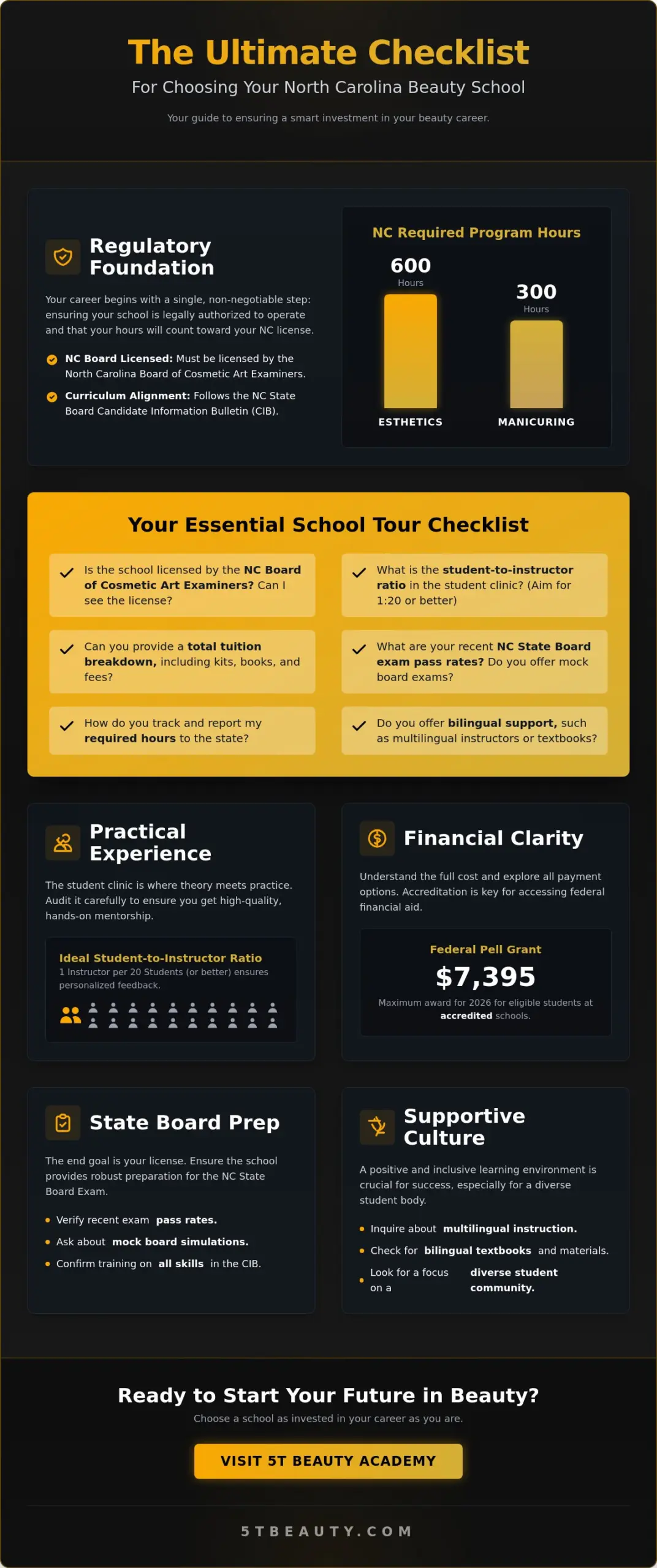
North Carolina has strict mandates for graduation. For those pursuing an Esthetics Program, you must complete 600 hours; for those in a Manicuring Program, the requirement is 300 hours. Life happens, so you need to know the school’s policy on attendance. Ask: “What happens if I miss a class? How do I make up hours?” You want a school that offers a structured makeup schedule so you stay on track. Ensure there is a healthy balance between theory hours and hands-on application. This balance is vital for completing your Esthetics Program in Raleigh within your planned timeframe.
Accreditation vs. State Licensing
It’s easy to confuse these two terms, but they serve different purposes. State licensing is mandatory for the school to operate and for you to work. Accreditation is a voluntary process that allows a school to offer federal financial aid. While both are signs of quality, state board approval is the foundation of your legal right to practice. The broader field of Cosmetology and personal care is highly regulated to ensure public safety. When finalizing your questions to ask a beauty school, ask about the specific credentials of the lead instructors. For any student in the Raleigh area, North Carolina Board approval is the absolute first step toward a successful career.
- Confirm License: Is the school currently in good standing with the NC Board of Cosmetic Art Examiners?
- Track Hours: How does the school digitalize and report your 600 or 300 hours?
- Audit History: Has the school passed its recent regulatory inspections?
Evaluating the Practical Experience: The Student Clinic Audit
The student clinic is the heart of your vocational education. It’s where you transition from practicing on mannequins to performing a real anti-aging facial or a classic manicure on a living client. When you tour a facility, don’t just look at the decor; you must audit the operational reality of the floor. One of the most critical questions to ask a beauty school is about their student-to-instructor ratio. Ideally, you want a ratio of 1:20 or better. If one instructor is responsible for too many students, you won’t get the immediate correction needed to master the pressure of a microdermabrasion wand or the precision of eyebrow waxing.
While the U.S. Department of Education provides the framework for institutional standards, the daily quality of your education depends on the tools in your hands. Ask about the brands the school uses. Are you working with professional-grade chemical peels and high-quality gel manicures? Learning on the same equipment used in top-tier salons ensures you’re day-one ready upon graduation. Inquire about the volume of real-world clients the school attracts. A busy clinic floor means more opportunities for you to refine your skills and build a professional portfolio before you even finish your program.
Hands-On Learning and Supervisor Ratios
Ask if instructors are always present to provide immediate feedback during services. You need to know there’s a structured “check-off” process for mastering new techniques before you’re allowed to work on the public. High-quality student clinic services in Raleigh often mirror the professional environment of a high-end spa. This exposure is vital for building your confidence. If you want to see a professional clinic in action, consider booking a service at our student clinic to experience the environment firsthand.
Client Diversity and Service Variety
Does the clinic offer a wide range of treatments, such as acne treatment facials or deluxe pedicures? A diverse service menu ensures you aren’t just repeating the same basic steps every day. Ask how the school handles difficult client situations. Learning how to manage expectations and maintain professionalism is just as important as the technical application of a pink and white full set. Finally, verify if the school provides a steady stream of clients or if you’re responsible for booking your own. A school with a strong community reputation will keep your station busy, giving you the repetitions you need to succeed.
- Start Date: How many hours of theory must I complete before I see my first client?
- Feedback Loop: How often do instructors provide written evaluations of my practical work?
- Equipment Access: Will I have my own dedicated space and tools during clinic hours?
Financials and Logistics: Beyond the Tuition Tag
Investing in your future requires a clear financial roadmap. While the excitement of starting an Esthetics Program is high, you must understand the full scope of your financial commitment. When preparing your list of questions to ask a beauty school, look beyond the primary tuition sticker. Request a comprehensive, line-item breakdown that includes registration fees, technology fees, and student kit costs. Many institutions offer internal payment plans for students who don’t qualify for federal aid. Ask about these flexible options early to ensure your education remains affordable and stress-free.
Hidden costs can quickly derail a student’s budget. Inquire about expenses that might not be in the initial quote, such as uniforms, state board exam fees, or supplemental textbooks. Beyond the money, consider your time. Evaluate the school’s schedule flexibility. Do they offer part-time or evening classes for working adults? A school that respects your existing work or family commitments is a partner in your long-term success. Choosing the right schedule ensures you can maintain your current responsibilities while building your new career.
The Student Kit and Supplemental Materials
Your student kit is your first professional arsenal. Ask to see it during your tour. Is it filled with professional-grade products for acne treatment facials and chemical peels, or is it a basic starter set? A high-quality kit must include every tool needed for the NC Esthetics Practical Exam. Verify if the school provides digital access to industry-standard curricula like Milady or Pivot Point. These digital resources are essential for mastering theory and preparing for your 2026 board exams.
Financial Assistance and Scholarships
Institutional scholarships can significantly reduce your out-of-pocket costs. Ask: “Do you offer any early-enrollment discounts or merit-based scholarships?” For the 2026-2027 award year, the maximum Federal Pell Grant is $7,395, which can cover a significant portion of your training at an accredited school. If you need additional funding, undergraduate direct loans for this period carry a fixed interest rate of 6.52%. Always verify the school’s refund policy in case an emergency forces you to withdraw. The “cheapest” school often costs more in the long run if it doesn’t lead to a license, so prioritize value and quality instruction over the lowest price tag.
- Total Breakdown: Get every fee in writing before signing an enrollment agreement.
- Payment Flexibility: Ask about monthly installments to avoid high-interest private loans.
- Kit Quality: Ensure the products provided are what you’ll actually use in a professional salon.
The End Goal: State Board Preparation and Career Support
Your education is a bridge. Passing the state board exam is the final hurdle between your training and your career as a licensed professional. When you’re finalizing your questions to ask a beauty school, you must focus on their track record of success. Ask for the school’s specific pass rate for the NC State Board Exam over the last two years. A high-ranking institution should be proud of these numbers and willing to share them. You aren’t just paying for classroom hours; you’re paying for a result. If a school can’t demonstrate consistent student success, it may not be providing the rigorous training you need to excel in the North Carolina beauty industry.
Beyond the exam, consider your life after graduation. Does the school have a strong network of local Raleigh spas and salons? Inquire about job placement assistance and how they help students transition into the workforce. A school that acts as a community builder will have deep roots in the local industry, making it easier for you to find your first professional home. Our instructional team is dedicated to your long-term success, ensuring you feel supported from your first day of class to your first day on the job. If you’re ready to start this journey, apply to our programs today and join a community that invests in your future.
Mock Exams and State Board Readiness
Ask: “How many times will I practice the practical exam before graduation?” You need a school that hosts “mock board exams” to simulate the high-pressure testing environment. These simulations should cover everything in the esthetician practical exam checklist, from sanitation protocols to specific service applications. Verify if the school provides the specialized bags and labeling required by the North Carolina Board of Cosmetic Art Examiners. Proper preparation prevents surprises on exam day. For those in our manicuring program, we recommend reviewing the nail tech state board practice test nc to understand the level of detail required for success.
Career Services and Networking
Does the school teach the “business side” of beauty? You need to master marketing, retail sales, and client retention to thrive in a competitive market. Ask if the school helps with resume building and interview preparation. Inquire about “Salon Days,” where local owners visit the campus to recruit new talent. These events are vital for networking and can lead to immediate employment after you secure your license. A vocational focus means your time is valuable, and every lesson should move you closer to your professional goals.
- Pass Rates: Request data specifically for the NC State Board practical and theory exams.
- Simulation: Ensure mock exams are graded with the same criteria used by state examiners.
- Business Training: Confirm the curriculum includes salon management and entrepreneurship skills.
Cultural Fit: Bilingual Support and Proprietary Training
The final step in your enrollment journey is finding a place where you feel seen, heard, and supported. A beauty school isn’t just a building; it’s a community where you’ll spend hundreds of hours perfecting your craft. When you’re crafting your final questions to ask a beauty school, you must look deeper than the curriculum. Evaluate the “vibe” of the campus during your tour. Is the atmosphere cold and clinical, or does it feel like a nurturing environment where students are encouraged to share their progress? A school that feels like a family will provide the emotional safety you need to take risks and master complex skills like chemical peels or full set acrylics.
Inquire about the diversity of both the student body and the faculty. A multicultural environment prepares you for the reality of a modern salon, where you’ll serve clients from all walks of life. Ask if the institution uses a proprietary methodology. Many high-ranking schools develop specialized techniques for services like anti-aging facials or deluxe pedicures that you won’t find in standard textbooks. Learning these unique approaches gives you a competitive edge when you enter the Raleigh job market. You want a school that is proud of its status but remains deeply focused on your individual success.
Bilingual Instruction and Linguistic Support
Linguistic barriers should never stand in the way of your professional dreams. If English isn’t your first language, one of your most important questions to ask a beauty school is about their multilingual resources. Ask if they provide textbooks or instruction in Spanish or Vietnamese. Can you take your internal theory exams in your native language to ensure you truly grasp the safety protocols? Choosing a bilingual beauty school in NC is a strategic move for community-based success. Verify if there are bilingual staff members available in the admissions or financial aid offices to help you navigate the enrollment process with clarity.
The Mentorship Model
Education is most effective when it’s personal. Ask if students have access to one-on-one mentorship with their instructors. You need to know that your teachers are invested in your specific career path. Does the school celebrate individual student milestones, such as reaching your first 100 hours or mastering a pink and white full set? Our brand embodies a “Nurturing Expert” approach where professional discipline meets deep personal support. This mentorship ensures you aren’t just another number in a large institution, but a valued member of a professional family.
- Native Language Support: Confirm the availability of bilingual instructors for technical training.
- Proprietary Methods: Ask how their specific teaching style differs from other local schools.
- Celebration of Success: Look for a school that publicly recognizes student achievements and growth.
Start Your Professional Journey with Confidence in Raleigh
Your future in the beauty industry depends on finding a school that translates your passion into a professional license. We’ve explored the essential metrics for success, from auditing the student clinic to ensuring your curriculum aligns with the 2026 North Carolina State Board requirements. Remember that the right questions to ask a beauty school should always focus on how they support your specific goals through hands-on experience and transparent financial planning. You deserve an environment that treats your education as a serious vocational investment.
At 5T Beauty Academy, we’re proud to be a community builder in the heart of Raleigh. We offer high NC State Board pass rates and a nurturing environment that celebrates every student milestone. Our team provides bilingual instruction in English, Vietnamese, and Spanish to ensure every student masters their craft with absolute clarity. Don’t leave your career to chance. Book Your Personalized Tour of 5T Beauty Academy Today! We can’t wait to welcome you into our professional family and help you launch your new career path with total confidence.
Frequently Asked Questions
What are the red flags to watch for during a beauty school tour?
Watch for unclean clinic floors, expired skin care products, or a lack of active instructor supervision. If an admissions officer gives evasive answers to your questions to ask a beauty school regarding state board pass rates or student-to-instructor ratios, consider it a major warning sign. A reputable institution should be transparent about its regulatory standing and the success of its graduates.
How much does beauty school typically cost in Raleigh, NC?
Total investment varies significantly based on whether you choose an esthetics or manicuring program and the quality of the included student kit. While average North Carolina cosmetology tuition often ranges between $16,024 and $17,150, specialized skin and nail programs usually have different price points. Always request a written breakdown of tuition, registration fees, and kit costs to avoid hidden expenses later.
Do I need a high school diploma to enroll in beauty school?
Yes, the North Carolina Board of Cosmetic Art Examiners requires a high school diploma or a GED for professional licensure. This requirement ensures you have the foundational knowledge necessary to master complex safety protocols and technical theory. If you have international credentials, ask the school if they provide linguistic support to help you verify your documents for state board approval.
Can I work while attending esthetician or nail technician school?
Many students successfully maintain part-time or full-time jobs while completing their vocational training. To make this possible, look for a school that offers flexible scheduling, such as evening classes or part-time tracks. Balancing work and school requires discipline, but it’s a practical way to manage your finances while you transition into a new career path.
What is the difference between a cosmetology school and an esthetics school?
Cosmetology schools provide a broad education covering hair, skin, and nails, while an esthetics school focuses exclusively on specialized skin care. Because 5T Beauty Academy specializes in esthetics and manicuring, we provide deep, concentrated instruction in treatments like chemical peels and microdermabrasion. This targeted approach allows you to become an expert in your chosen niche rather than a generalist.
How long does it take to graduate from an esthetics program in North Carolina?
Your graduation timeline depends on how quickly you complete the 600 hours required by the North Carolina state board. Full-time students typically finish the program in four to six months. If you choose a part-time schedule to accommodate other responsibilities, you can expect to graduate in approximately eight to ten months of consistent attendance.
What happens if I fail the NC State Board exam after graduating?
You can retake the exam, but you’ll need to reapply and pay the testing fees again according to state board procedures. To avoid this, prioritize questions to ask a beauty school about their mock exam process and prep courses. Schools that simulate the high-pressure testing environment significantly increase your chances of passing both the theory and practical portions on your first try.
Does 5T Beauty Academy offer financial aid or payment plans?
We provide multiple pathways to help you fund your education, including internal payment plans designed for those who don’t qualify for federal aid. For the 2026-2027 award year, eligible students can also utilize the Federal Pell Grant, which has a maximum award of $7,395. Our admissions team is dedicated to helping you navigate these options so you can focus on your professional growth.